1日目: Open Source Stewardship Communities: "We need you, but not your pull request"
I have been working on the impact of Agentic AI on open source communities. One of the most striking changes is that open source projects are closing pull-requests to outsiders.
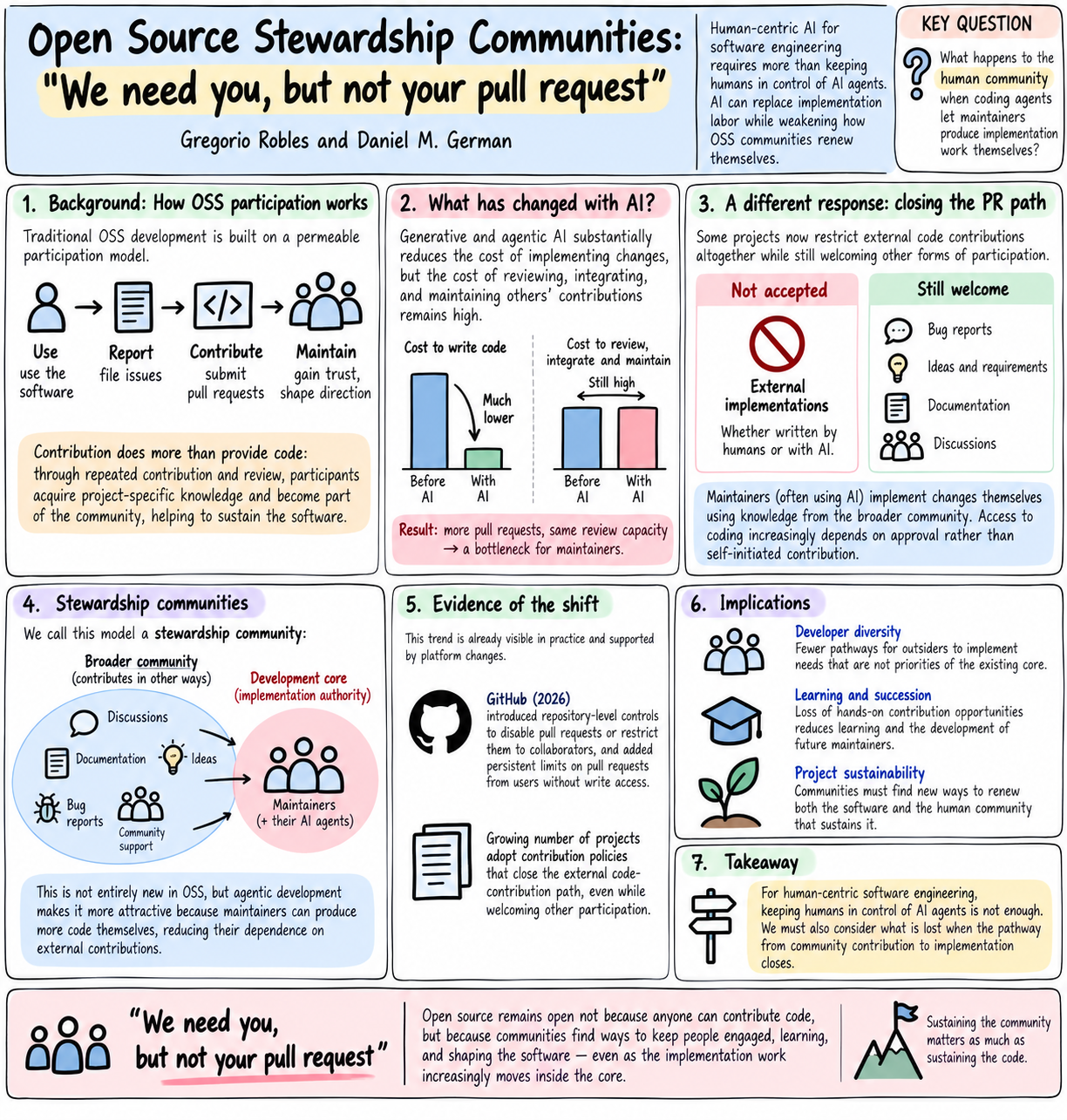
I think it makes sense: coding used to be the most expensive activity of building open source. No longer, agents can do in minutes what developers would do in a day. Thus, the need for outsider contributors is diminished. I often ask myself: would I review an external contribution and make sure it works, or would I rather ask my agent to do it? at this point, I choose the later. And this is starting to happen in several OSS projects.
When PRs are closed, the first affected is the "community". PRs was a way to grow the developer team of an OSS, making it resilient to losing its original developers. When no code external contribution are allowed, how is the project going to foster its future maintainers?
Open Source Stewardship Communities: "We need you, but not your pull request"
This is the abstract:
Human-centric AI for software engineering means keeping humans responsible for work performed with AI. In Open Source Software (OSS), AI lowers the cost of implementing changes, but reviewing someone else's contribution remains comparatively expensive, so some projects now restrict who may contribute implementations while still welcoming other participation—not because the code is AI-generated, but because it no longer justifies the review cost. We call the resulting form a stewardship community: a small core retains implementation authority while a broader community continues to shape the software without writing code, and access to coding increasingly depends on approval rather than self-initiated contribution. This raises a broader question: what happens to the human community when coding agents let maintainers replace implementation work once supplied by external contributors? For human-centric software engineering, keeping humans in control of AI agents is not enough: AI can replace implementation labor while weakening how OSS communities renew themselves.
And visual notes if you don't want to read the whole thing: